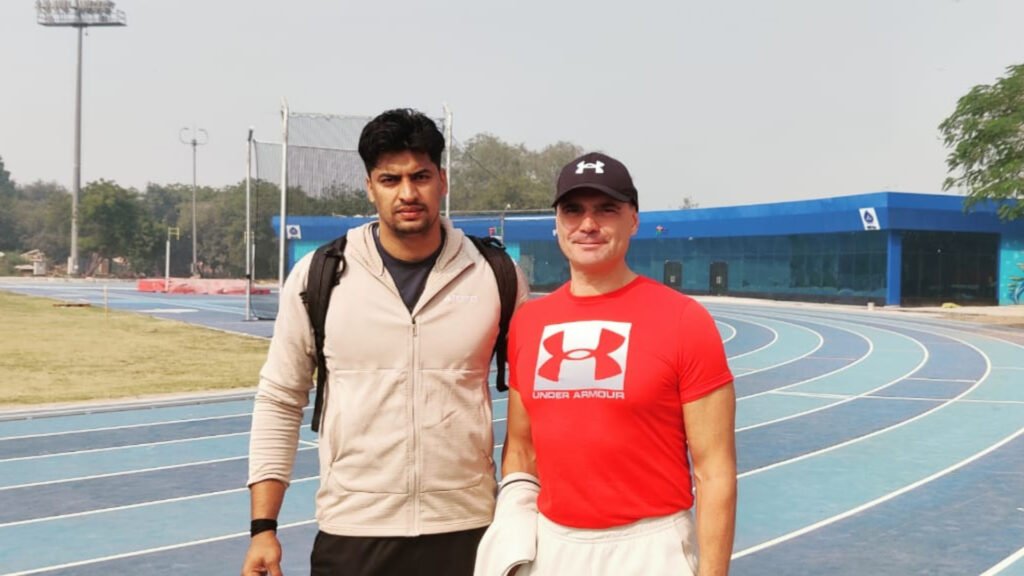
| Delhi’s Jawaharlal Nehru Stadium – long the venue of grand events but too many empty seats — is quietly turning into the beating heart of India’s javelin movement. The transformation isn’t hype. It’s already in motion.
Asian Championships medalist and World Championships 2025 fourth-place finisher Sachin Yadav now trains full-time here with coaches Naval Singh and Sergey Makarov, the former world medalist. And joining him in Delhi this week is Shivam Lohakare, India’s fastest riser over 80 metres this season in not one, but three competitions.
As per information accessed by NNIS Sports, Delhi will be the primary training hub for India’s leading javelin athletes until March 2025. A quiet shift like this could define the next stage of India’s dominance in the sport.
Why JLN Stadium matters so much:
The biggest upgrade?
India finally has its first outdoor Mondo track — laid just months ago. For years, elite throwers trained on worn-out surfaces in Patiala and New Delhi. Everyone knew it slowed progress. No one could fix it. Until now.
Here’s what this new surface unlocks:
 Better traction = cleaner, safer throws Better traction = cleaner, safer throws
The Mondo runway lets an athlete lock their front foot, transfer all the force into the spear, and release with confidence. No slide. No collapse. Fewer injury scares.
 Less pounding on the body Less pounding on the body
The synthetic base softens impact during long run-ups, saving the knees, ankles and hips — the exact zones that suffer most over a heavy training season.
 No “adjustment period” abroad No “adjustment period” abroad
Major global meets use Mondo.
Now India does too. Athletes walk in ready to launch from Throw No. 1.
India’s javelin rise has receipts.
In just five years, Indian athletes — men and women — have won:
2 Olympic medals
2 World Championships medals
1 Diamond League title
3 Asian Games medals
2 Asian Championships medals
1 Commonwealth Games medal
This surge begins with Neeraj Chopra and his Olympic gold… but it doesn’t end with him.
A whole new batch is pushing through:
Shivam Lohakare — repeatedly breaching 80m
Himanshu — U-18 Asian Championships medalist
Dipesh Choudhary — Junior Federation Cup winner
Aditya — World No. 4 in U-20 rankings this year
These are not isolated bright days. These are signs of a system beginning to grow.
The Delhi shift is a positive signal.
Centralising training at JLN Stadium gives India one strong base, one shared culture, and one world-class runway.
Athletes training side by side push each other. Coaches get to work closely and consistently. And India’s next round of javelin medals suddenly looks a little more possible.
From a stadium that once struggled to fill its stands to a place where India’s best javelins now take flight, Delhi’s JLN Stadium is not just a venue anymore. It is becoming the starting point of India’s next big throw. |


 Emergingsports
October 6, 2025
Emergingsports
October 6, 2025