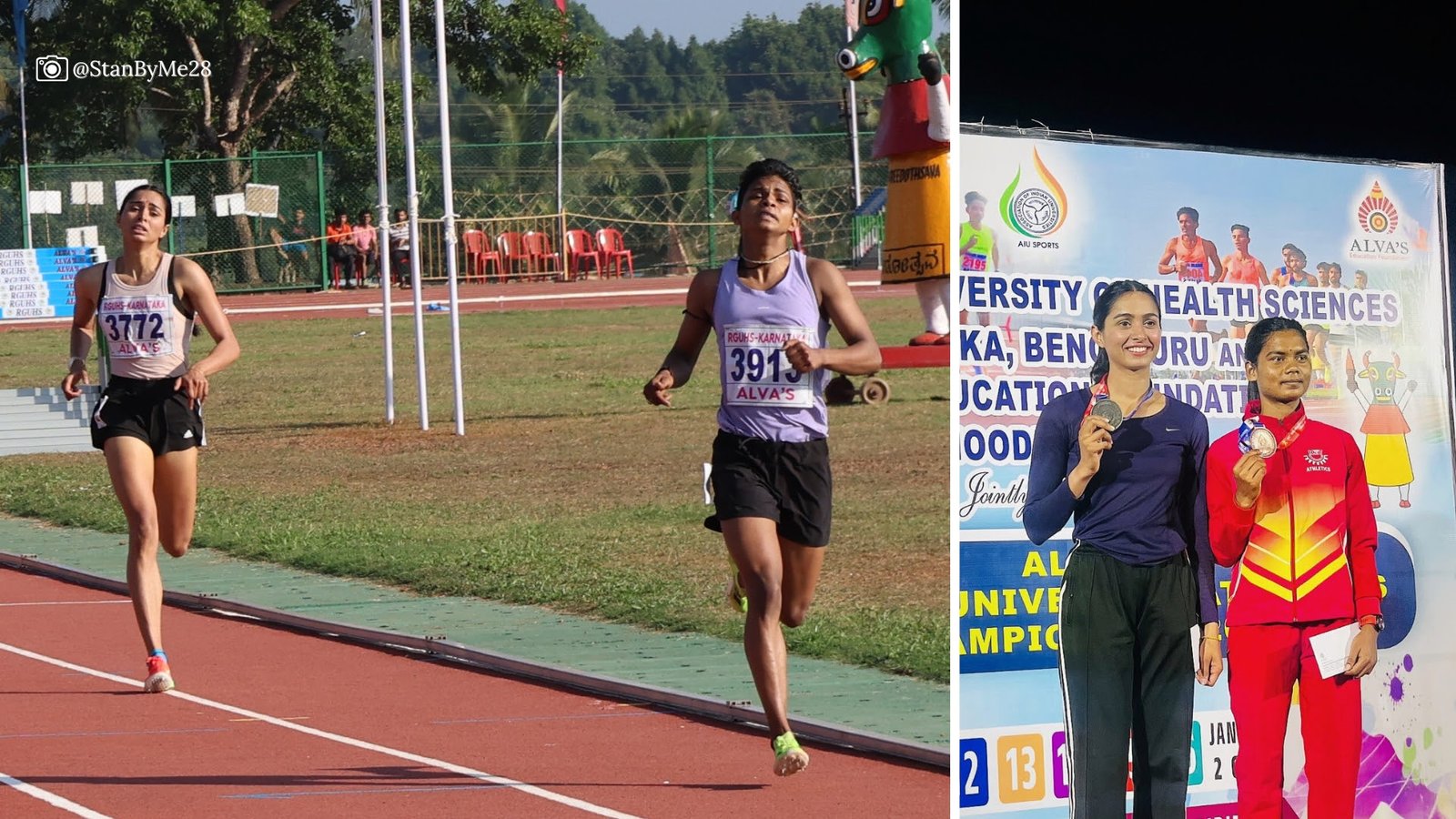
At the recently concluded All India Inter-University Athletics Championships 2026, Anju won the women’s 800m final, clocking a lifetime best of 2:08.43 to finish first.
However, moments after completing the race, Anju was seen continuing to run and avoiding photographers, as noted by a journalist on social media.
Later that evening, the results were revised, with Anju’s name marked as “SCR” (scratched). Anjali Mavi of Guru Nanak Dev University, who had originally finished second in 2:09.50, was upgraded to gold.
According to media reports, H.B. Radhakrishna, manager of the All India University meet, stated that Anju did not report for the medal ceremony to collect her gold medal and the accompanying ₹15,000 cash prize.
As per reports, the jury gave the team manager 24 hours to produce the athlete. After the stipulated time, the manager reportedly submitted a written statement saying, “She is not here, and she is not under my control.” Based on this, the jury decided to revise the result and scratch out the original winner.
However, when nnis Sports contacted Lovely Professional University manager Madhur, who was travelling back from Mangalore and speaking from a train, he denied this version.
“No, I requested the jury for the medal and even submitted a written application stating that Anju had a serious personal issue due to which she had to leave. I also presented her flight tickets, which were for 8 pm on the same day,” Madhur said.
When asked whether the incident was linked to NADA, Madhur clarified:
“No, NADA was not there. After reaching her hotel, Anju called me and said she would return immediately if any NADA official contacted her.”
This raises a critical question: Can an organising committee legally cancel or withdraw an athlete’s medal solely for failing to attend the medal ceremony?
Multiple attempts by nnis Sports to contact Anju were unsuccessful, as her phone remained unreachable.
In the updated results:
Gold: Anjali Mavi (Guru Nanak Dev University)
Silver: Laxmi Priya Kisan (KIIT University)
Bronze: Anisha Patel |
|
India’s women’s 400m is showing serious lapses ahead of the 2026 season. With two major competitions coming up, the Asian Games and the Commonwealth Games, the current state of the women’s 400m squad is creating doubt.
Before we start, it is important to remember that at the Asian Games 2023, the Indian women’s 4x400m team won silver. The team consisted of Vithya Ramraj, Aishwarya Mishra, Prachi Choudhary, and Subha Venkatesan. Last season, AFI appointed a dedicated coach for the women’s 400m, Jerry Lee Holness, a renowned Jamaican coach. As per AFI, all camps have been decentralised except the 400m camp at NCOE Trivandrum.
It is also important to note that AFI has a strict policy of including athletes in the 400m relay only from the camp, which, according to them, reduces the risk of doping that could later disqualify the entire team. However, last year, Sneha K, who tested positive for Stanozolol, was a camper and was training with the team. She was part of the relay squad that went to the World Relays to represent India and ran the second leg for India’s mixed relay team. She was tested by AIU there and returned a positive test, which later led to the team’s disqualification.
Now, if we look at the top six timings of 2025 in women’s 400m, out of the six, there are only two campers. One of them is Sneha K, who is currently suspended, leaving only Rupal. Rupal trains under Jason Dawson, the men’s team coach, and not under Jerry. She is also currently suffering from a knee injury and has not been able to train, which casts a shadow over her season. |
 |
| This means there are effectively no campers in the top six who are currently able to be part of the relay team. If we look at the top eight, there is only one other camper, Subha Venkatesan, who is eighth with a season best of 53.35s.
Although when it comes to relays, there is no one more experienced than Subha, her anchor leg run at the Asian Athletics Championships 2025 still gives goosebumps to many. She is known as India’s GOAT in relay events. However, she last competed at the Asian Athletics last year, and several reports suggest she has been suffering from an injury since then.
The Sports Ministry recently updated the TOP Scheme list, where they included Jyothika Sri Dandi, Subha Venkatesan, Jisna Mathew, and Rupal as 4x400m probables. But out of these four, Rupal and Subha are injured. Jyothika has been injured since last year and has not competed since then, while Jisna last competed in August 2025, and her season-best timings place her tenth in India this season.
nnis Sports reached out to several coaches to understand their views on the women’s 4x400m relay ahead of the Asian Games. One coach reacted, “Planning for the women’s relay this season has been very uncertain, and AFI’s new coach, Jerry Lee Holness, has not been able to produce results. Among the top four Indian women in the 400m this season, only one—Rupal—is a camp athlete, and even she trains under Jason, not Jerry.”
The coach further added, “Neeru, Aishwarya, Kiran Pahal, and Himanshi Malik are very inconsistent athletes. You cannot rely on them for a long-term plan. On the other hand, Jyothika, Poovamma, Vithya, Rupal, and Subha are consistent performers—some are in camp, others are outside. If they are properly channelled and given opportunities to run in the relay, they could be a strong option for the Asian Games 2026, especially since the other camp athletes are juniors currently running in the 54–55 second range.”
The plan AFI is expected to execute is to finalise the relay team at the Open 400m on March 28, 2026, which will be the season opener for all athletes. They will then have to decide the team for the Relay Carnival in Chandigarh on April 18.
Looking at the current state of the women’s 400m campers, AFI may have only one option left: to include athletes from outside the camp who are currently under the RTP list of NADA. |
|
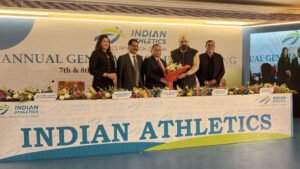
The Athletics Federation of India (AFI) has unveiled its qualification norms for the Asian Games 2026, choosing to announce the criteria well in advance to give athletes clarity on their targets. Explaining the rationale to the media, an AFI spokesperson said the early announcement was aimed at helping athletes plan their seasons without ambiguity.
Among the key decisions, the Interstate Athletics Championships will serve as the final selection trials for both the Commonwealth Games (CWG) and the Asian Games. To be eligible for the Interstates, athletes must compete in at least two national-level competitions and one State meet. Failure to meet this requirement will result in disqualification from the final trials.
AFI officials clarified that this rule has been introduced to discourage athletes from peaking early merely to breach qualification marks and then underperforming at major championships. The standards themselves have sparked debate, with several athletes pointing out that in at least three events, the qualification benchmark requires bettering the national record.
Responding to the criticism, AFI official Adille said the standards were intentionally set high. “We don’t want to take passengers to the Games,” he said, adding that only athletes capable of challenging for podium finishes should qualify.
However, uncertainty remains around the Commonwealth Games selection criteria, which is yet to be officially announced, despite the CWG being scheduled just a month before the Asian Games. While there is no formal confirmation, AFI is reportedly considering selecting teams for both events from the Interstate Championships. Whether this will mean separate squads or overlapping teams is still unclear.
AFI has made it clear that the Asian Games is the priority for the season, though the Commonwealth Games continues to hold importance due to the quality of competition, with strong nations such as England, Jamaica, and South Africa in the fray.
THE PEAKING DILEMMA
The biggest concern emerging from the new framework is the challenge of multiple peaking. The AFI calendar includes three major domestic competitions: the Federation Cup, Interstates, and Open Nationals. Athletes must compete in at least two competitions to be eligible for the Federation Cup, and at least three competitions, including a State meet, to take part in the Interstates and Open Nationals.
In effect, athletes are required to participate in a minimum of six national-level competitions, with at least three directly linked to Asian Games qualification.
nnis Sports spoke to several coaches to understand the impact of this structure. Opinions were divided.
The Interstate Championships are scheduled from July 8 to 12, 2026, followed closely by the Commonwealth Games from July 23 to August 2, and the Asian Games from September 19 to October 4.
A coach who primarily works with budding athletes expressed strong reservations. “Nothing is clear about how the Commonwealth Games team will be selected,” he said. “What is the point of finalising the Asian Games team at the Interstates in July? Athletes will give their best-ever performance there. If they qualify, how do they maintain peak form for two months? At best, an athlete can hold peak performance for three weeks. This system favours elite athletes, not those trying to break through for the first time.”
In contrast, a coach who trains elite athletes welcomed the move. “It’s a very good decision,” he said. “AFI has ensured that only genuine, consistent athletes succeed, not one-time performers. Competing in six to eight competitions before major championships is normal globally. More competition matures athletes and prepares them to deliver when it matters most.”
As Indian athletics enters a crucial qualification phase, AFI’s high benchmark, high competition approach has set the stage for a season that promises both opportunity and intense debate